Tuesday, August 25, 2020

Comparing the Candidates: Real Estate Issues

To say that there are strong feelings about this year's election would be an understatement. There's a lot to pay attention to, but let's take just one issue today and break it down. How do Trump and Biden approach housing issues?

Discrimination

  • Trump repealed the Affirmatively Furthering Fair Housing Rule, which requires jurisdictions that receive federal housing funds to assess any patterns of discrimination and plan to diminish them. Advocates say that the rule gave HUD the teeth to enforce provisions of the Fair Housing Act of 1968. Trump pursues actions that generally loosen regulations for various industries, and has stated that the AFFHR represents further government encroachment.
  • Biden, on the other hand, plans to use legislation to enforce fair housing policy, although he does want to prohibit certain local exclusionary zoning laws. He's interested in creating a Homeowner and Renter Bill of Rights to add more consumer protections in the lending process and housing access.

Affordability

  • The AFFHR repeal also broadens the definition of affordable housing and allows jurisdictions more leeway to decide what actions they need to take, if any. HUD Secretary Ben Carson says it will reduce the barriers to compliance for cities and developers. Critics say the subjectivity will scale down efforts to provide affordable housing. Trump's 2017 tax cuts also included incentives for developers to build in "opportunity zones." 
  • Like Trump, Biden takes a supply-and-demand approach to housing affordability. He has stated that he would invest $640 billion over the next 10 years to both provide direct financial assistance to consumers and increase support of other initiatives that address efficiency and accessibility.

Taxes

  • Trump's tax plan also limited the amount of state and local property taxes that people could deduct on their federal tax returns. The effects of this action were predominately felt in higher priced housing areas such as New York and San Francisco where mortgages regularly exceed the new cap.
  • Biden has said, if elected, her will roll back Trump's tax cuts. He has also mentioned enacting a $15,000 tax credit for first-time homebuyers.

Renting

  • The administration mandated a 4-month moratorium on evictions for federally assisted properties during the COVID crisis. His most recent order did not extend the moratorium but encouraged landlords to try to find ways to work with tenants to allow them to stay.
  • Biden would encourage localities to create "eviction diversion programs" including mediation and payment plans. He would also like to provide tenants facing eviction with legal assistance. He is calling for rental relief for those suffering from the coronavirus.

Homelessness

  • Trump has been very vocal in his criticism of the California governor and mayors in their handling of the homelessness crisis in that state. The coronavirus relief packages included nearly $3 billion in homeless assistance funding. 
  • Biden is taking a "housing first" strategy to address homelessness, calling for housing funding, vouchers and special programs for certain groups like veterans and the disabled.


I would love to help you with your real estate journey. 
Please contact me at 303-917-7143 or robbin@elevatedrealestate.com

Monday, August 10, 2020

5 Questions to Ask When Buying a House

Visit houselogic.com for more articles like this.

© Copyright 2020 NATIONAL ASSOCIATION OF REALTORS®


I would love to help you with your real estate journey. 
Please contact me at 303-917-7143 or robbin@elevatedrealestate.com

Tuesday, August 4, 2020

Getting Your Property Ready to List

When I visit my clients' homes with my stager, I make sure to tell them that how you stage a home to sell if much different than how you live in it. Our goal is to make the broadest appeal to the most buyers as possible by decluttering, neutralizing colors/styles, and addressing repairs.

As a seller, it's in your best interests to know your property's weaknesses before being surprised by buyer feedback or inspection requests. Your agent should give you her opinion on your market challenges, such as backing to a busy road or having outdated finishes, and help you adjust your listing price accordingly. I always recommend that a seller pretend they are a buyer and walk around and through their house with a critical eye, trying to find anything a buyer could pick on. Often we live in our house and don't notice little things like missing trim or a leaky faucet. Not only could these things possibly result in a lower contract price but they can make the buyer wonder what else in the home has not been maintained that they can't readily see.

It's important that your major components are functioning correctly, like your HVAC system, roof, plumbing, etc. Buyers almost always ask for the HVAC system to be cleaned and serviced, so you might as well get it done before listing. This way, if you discover a needed repair you can also take care of it right away - if the buyer finds it during inspection, they may request a whole new system or a significant monetary credit. If you think there may be hail damage to your roof, you will then have time to put in a claim to your insurance company. A brand new roof is a great thing to advertise to potential buyers. If your systems are old but functioning fine, offering a home warranty for the buyer's first year may give them some peace of mind.

Some areas, like many of our Colorado neighborhoods, have issues with expansive soils. These can present as cracks in the drywall, sinking sidewalks, heaving garage floors, or worse - foundation cracks and shifting structures. Many properties here have cracks in their garage floors or walks, and sometimes it may be a good idea to have them mudjacked or repoured. If you've had to address structural issues in the past, it's worth it to hire a structural engineer for a current report that says everything is still performing well. Structural issues are the biggest red flag that buyers run away from, so doing your homework ahead of time will save you time on the market and dollars on the table.

Minor repairs may not seem like a big deal to some sellers if they've been living with them for a while. It's a used house, after all, but these are the kind of things that make buyers wonder if you have paid attention to regular maintenance. Plus, they are fast and relatively inexpensive things to take care of yourself or hire a handyman to do. Scrape and retouch any peeling paint on trim or siding. Make sure your toilets are tight to the floor and your downspouts have extenders. Remove moldy caulk and tighten that loose railing. Paint that red accent wall white and cover the exposed weedblock with more mulch.

If you tend to have a lot of furniture or accessories, removing everything you don't need for the next few months is the way to go. You're going to have to pack it sooner or later, so doing it now will allow buyers the mental space to picture their own furnishings in the home. If you have an off-site place to store things that's ideal, but the garage will work in a pinch. Just be sure that buyers can get into the garage and see the floors and walls during inspection. Having a few family photos up in okay, but take down that gallery wall in the hallway and fill all the nail holes. Remove religious or political items, and hide the deer heads in the basement for now. Stagers can help you rearrange furniture so that the rooms looks as big as possible, and add artwork and color to the spaces to give it a final polish before photographs and showings. 

Everyone wants top dollar when they sell; using a critical eye and being a ruthless buyer for a few minutes can help get you there. My stager and I are happy to come to your home and help you make a to-do list, even if you aren't going to be ready to sell for a while!


I would love to help you with your real estate journey. 
Please contact me at 303-917-7143 or robbin@elevatedrealestate.com

Monday, July 27, 2020

It's Time to Define the Relationship

The sentence that has stopped many a date in its tracks. This conversation will be much easier, I promise, but not less important if you want to protect your financial interests. The working relationship you adopt with your real estate agent will outline their responsibilities and your risk. In the state of Colorado, there are 4 defined and allowable types:
  • Seller's Agent. A Seller's Agent is a representative of the seller, advocating for her client and looking out for their best interests. She prepares necessary documents and advises the seller on process and negotiations. Everything a client tells a seller's agent must remain confidential, and anything pertinent the agent discovers about the buyer must be reported back to the seller. The agent works on behalf of the seller with the utmost good faith, loyalty and fidelity. An agreement must be signed in order to create this relationship.
  • Buyer's Agent. As you can probably guess, the Buyer's Agent is a representative of the buyer. She advises, negotiates and protect the interests of her client, just as a Seller's Agent does. Everything discussed between the buyer and buyer's agent must remain confidential, and the agent must follow the buyer's directions as long as they are not illegal. An agreement must be signed for this relationship, as well.
  • Transaction Broker. A TB is a neutral facilitator of a transaction, and in the absence of a seller or buyer agency agreement this is the default relationship. Once an agent begins to act on behalf of another person, this relationship kicks in. The TB prepares documents and must keep information confidential, but they cannot advise a client on what to do or advocate on their behalf. This relationship may be retained if a client is uncomfortable with making a commitment to only working with one agent, or during a double-ended deal. This is when the agent is working for both the seller and buyer on the same transaction. In the state of Colorado, Dual Agency is not allowed, meaning the agent cannot be an advocate for both parties. The stats commission feels there is no way to accomplish this without a conflict of interest, but they do allow a TB to perform every other act necessary to complete a real estate transaction.
  • Customer. A customer is a party that an agent may be helping but with which she has none of the relationships above. An example of this would be an unrepresented buyer attending an open house that a Seller's Agent is hosting. If the customer requests it, a Seller's Agent can help the buyer draw up an offer for the property but remains loyal to the seller. This is permitted as long as the customer understands the restrictions of the situation and is comfortable representing themselves in the transaction.


Real estate agents are required to provide this information to a potential real estate contact as soon as possible during an encounter that may result in a business relationship. To protect the public, agents are encouraged to have these definitions printed at open houses and signed before touring houses together or otherwise exchanging any information besides pleasantries. If the agent you encounter doesn't explain the relationships above in some fashion before making inquiries into your real estate needs, this should be a consideration as you make decisions about with whom to work.


I would love to help you with your real estate journey. 
Please contact me at 303-917-7143 or robbin@elevatedrealestate.com

Saturday, July 25, 2020

5 Small Backyard Ideas to Make Your Cramped Outdoor Space Feel Like Versailles

Don't think of your microscopic yard as a curse. So what if it's technically a small, concrete slab that barely accommodates a half-sized Weber grill? Or if your flagstone patio is just big enough for you, a lounge chair and a good book? Your tiny outdoor spot is actually an opportunity to get creative.

To live large with a small footprint, try these functional tweaks to make your minuscule outdoor space feel like a palatial retreat.


I would love to help you with your real estate journey. 
Please contact me at 303-917-7143 or robbin@elevatedrealestate.com

Tuesday, July 14, 2020

Boulder County 2Q20 Stats

How we have fared through the most restrictive part of the quarantine is beginning to become apparent. For single family detached dwellings, we are down over 16% in active listings compared to this time last year. We can feel that, too, as there are once again multiple offer situations happening throughout the Denver metro area. The median and average sales prices have taken a small hit but I think that's due to the higher priced homes taking a little longer to sell resulting in a few more price reductions than normal. Homes under $500,000 are still going fast, and even the really rough properties are going under contract quickly to investors. 


We're seeing in increase in days on market of 3.4% for detached homes which is likely the COVID effect. Even though houses in certain areas are flying off of the market it is not the majority of properties. Buyers are getting more cautious and tired of getting beaten up by bidding wars and are less likely just to take whatever the seller is dishing out. Inspection repair requests should be taken seriously by the sellers that receive them as buyers are willing to walk if major concerns can't get addressed.


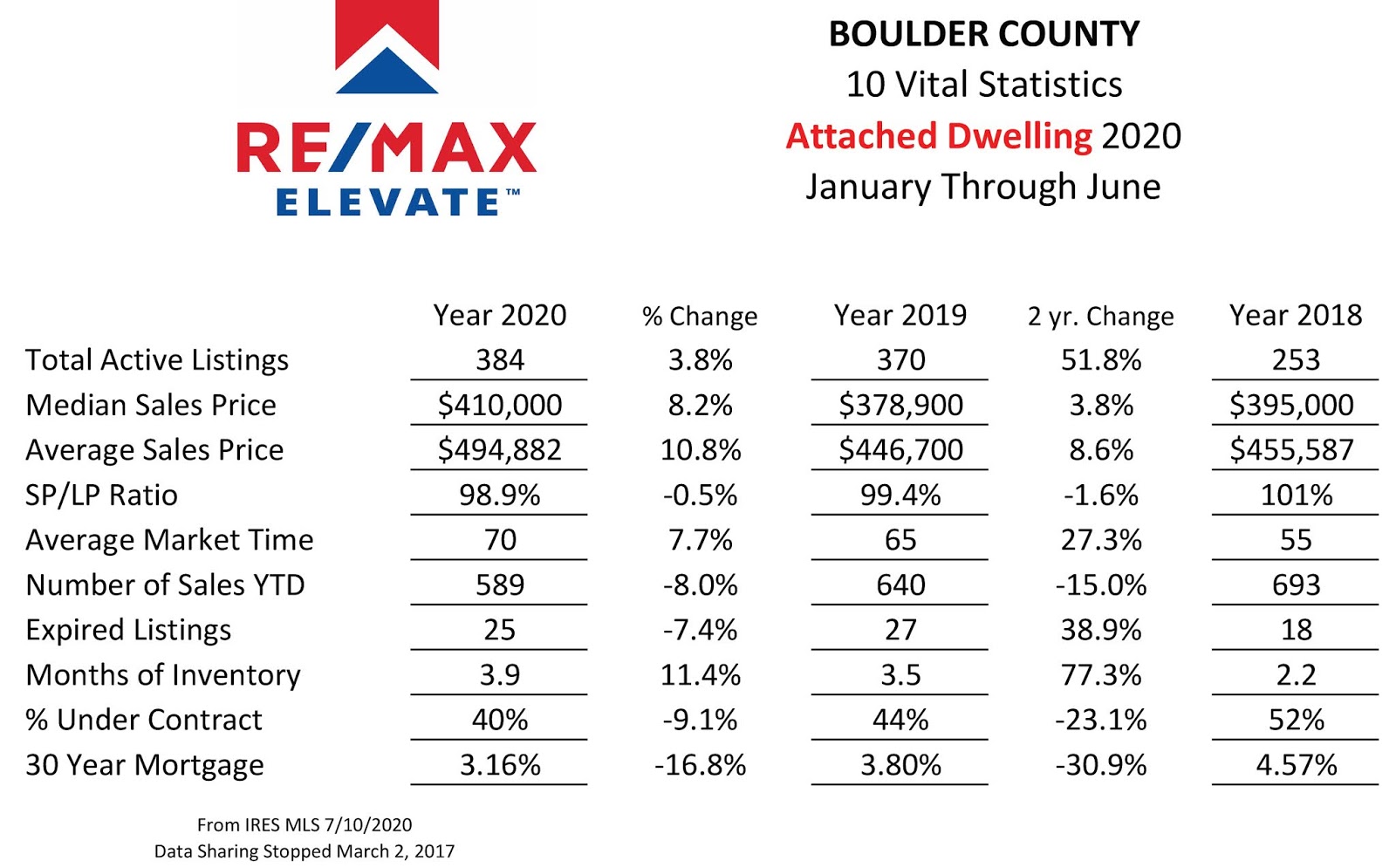
Attached dwellings - duplexes, townhouses and condos - saw an increase in total number of listings the first half of the year, with the median and average sales price also going up. Like detached homes, they are also generally sitting on the market a little longer than this time last year. Even so, we are still under the 4-6 month inventory rule of thumb that indicates a balanced market. 

I know Boulder County is unique in a lot of ways, so if you would like a market analysis on your area, don't hesitate to contact me - I do a lot of work south and east of my office and it's still a good time to sell!


I would love to help you with your real estate journey. 
Please contact me at 303-917-7143 or robbin@elevatedrealestate.com
Monday, July 6, 2020

Broomfield Heights 2Q20 Stats

Second quarter stats are in for 1st Filing! The number of sales remains strong despite the virus interrupting market activity. 


However, our $/sqft slid more than 6% from this time last year. This could be partly due to more than 40% of the properties being sold off market, or not in the Multiple Listing Service. A couple of those were severely under typical market value. This lack of exposure to the general market can result in a seller leaving money on the table. 


Of course, we don't know all of the factors - perhaps there were structural or other large issues that necessitated a discount, or one family member was selling to another at an intentionally lower price. But without this information, these kinds of sales can affect appraisals and neighborhood appreciation trends. If you'd like a free evaluation of your home, don't hesitate to reach out!


I would love to help you with your real estate journey. 
Please contact me at 303-917-7143 or robbin@elevatedrealestate.com